What is Media?
Definition of Media/Medium : an intervening agency, means, or instrument by which something is conveyed or accomplished. "Words are a medium of expression."
To put it simply, media is a platform for communication.
 |
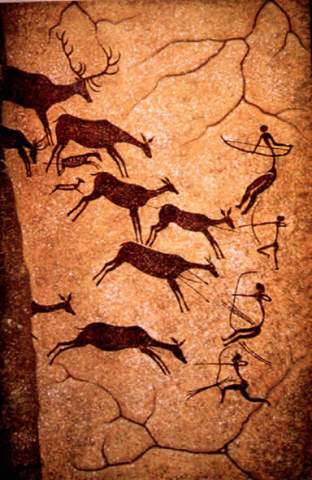
| http://deitchman.com/mcneillslides/images/Lascaux-hunters.jpg |
Humans need to communicate with one another. Our primitive ancestors invented ways to communicate with one another through cave drawings. They used facial expressions and body language to communicate. Thus, even the human body could be considered as a medium at that time. Later on when speech and writing was invented, humans wrote letters to one another. Messengers or doves carried their messages.
Fast forward to the present day, we have invented so many ways to communicate with each other. Letters, Radio, Telephones, Newspapers, Short-Message Service(S.M.S), Blogs, Youtube, Facebook and Twitter.
The list just goes on and on.
What is Old Media?
So what exactly is old media?
Old Media refers to traditional ways of communication before the rise of the internet.
 |
| http://www.abc.net.au/unleashed/images/newspaper_400.jpg |
Some examples of Old Media are:
- Television
- Radio
- Newspapers
- Magazines
- Books
- Most other printed publications
What is New Media?
New Media is the combination of traditional media with interactive power of the computer, communications technology and the internet.
 |
| http://flosse.blogging.fi/files/2009/12/holy-trinity-new-media.png |
New Media can be difficult to define as it must be revised every years. A perfect example would be Youtube.
Just 6 years ago, Youtube did not even exist! In just six years, it has grown from an unknown virtually unknown website into the global phenomenon we know today.
Let us take a look at some examples of New Media:
- The Internet
- Twitter
- Blogs
- Facebook
- Youtube
- Video Blogs(Vlogs)
- Podcasts
- Forums


Pros and Cons
 |
| http://www.mondaynote.com/wp-content/uploads/2010/01/one-in-many.jpg |
Old Media : One-To-Many
Pros:
- Familiarity. People are globally comfortable with it
- Not very reliant on electricity
- Poorer countries still more reliant on it
- Credibility
- More trustable
- Spend less time online; more time for family and friends
Cons:
- Not as portable and convenient
- Limited content
- Have to pay for information
- Slowly updated
- Short shelf-life. Once the day its printed passes, it becomes history
 |
| http://www.dreamstime.com/people-multiplying-1-thumb8215554.jpg |
Pros:
- Interactivity
- User-generated content
- Encourages creativity and sharing
- Highly convenient
- Unlimited content
- Increase transparency of government
- Can keep in touch with loved ones from any where in the world
Cons:
- Writers deliver content inconsistently
- Some content cannot be trusted
- Reliant on electricity
- Cannot be used in rural areas with no internet and wireless connection
- Negatively affect our social lives and communication skills due to over-reliance on internet and phones
- Spend more time online; can have bad effects on our health
- Can cause internet and gaming addiction
- Danger of exposure to pornography to the young
- Lack of privacy
Is Old Media Dying? Can It Survive?
 |
| http://laurelpapworth.com/wp-content/uploads/2009/03/newspapers-dead.jpg |
Is the influence of old media fading?
The answer to the question would be a resounding yes.
But has new media taken over it? Maybe. Maybe not...Yet.
Its a fact that New Media has made our lives easier. People used to rely on yellow pages to find services before the advent of the internet. Yes, it has made things easier and also more efficient. The services provided online can be updated frequently. However, yellow pages are still more trustworthy. You never know when an ad posted online might be a scam.
There are over 6 billion people in the world. Hamadoun Toure, head of UN's telecommunication agency recently revealed that the number of internet users in the world has crossed the 2 billion mark. That means that there are still 4 billion people in the world who have not started using New Media.
 |
| http://blog.techsoup.org/files/images/Image/yellowpages.jpg |
Collaboration of Old and New Media
Newspapers and magazines have seen a drop in subscribers. Books publishers are not earning as much due to drop in sales.
 |
Of course there are exceptions like Stephenie Meyer's Twilight.
Online forums, Youtube videos encourage fans of the book to come together.
In a way, it has also made use of the power of the internet to gain popularity. This is an example of how new and old media can work together.
However, television still going strong. This is because it combines old media and new media, to create interactivity. We can see Facebook and Twitter making appearances on television everywhere. From advertisements, to news programs with their own Facebook page.
Newspapers and magazines have also started to incorporate website links in their pages. Many newspapers and magazines have an online version of their articles.
Some examples would be Singapore's "Today" newspaper and Men's Health magazine.
Instead of fighting it out with each other, i believe that old and new media should work together.
Conclusion
Newspaper---> Radio--->Television---> Internet---> ???
We can see how our means of communication have evolved over the years. Perhaps in 10 years, the new media of today would become the new media of yesterday.
Here's a question to you.
What do you think comes after the Internet? Do you think something even bigger than Google and Facebook might appear?
Feel free to leave comments and Thank you for reading!
References :
http://whatsnewmedia.org/
http://en.wikipedia.org/wiki/New_media
http://www.npr.org/templates/story/story.php?storyId=6542596
http://www.huffingtonpost.com/2009/02/08/why-television-is-an-old_n_165009.html
http://flowtv.org/2009/12/new-media-is-neither-new-nor-media-discussdavid-parry-university-of-texas-at-dallas/